Friday, August 2, 2013

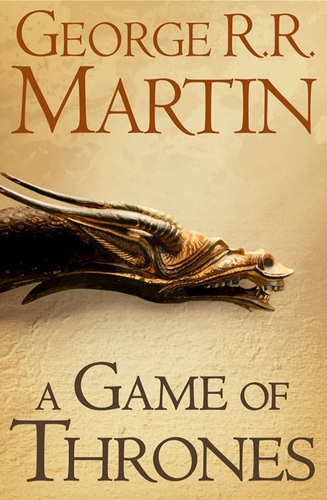
A Song of Ice and Fire: A Game of Thrones by George R. R. Martin

Not for the weak willed or the impatient; A Game of Thrones is the first mythical masterpiece in the series
that is gripping the world. The meticulously detailed book will really test your mettle, but believe me when I tell you, it is worth every second you spend reading.

This book was first brought to my attention by the smash-hit television series HBO’s Game of Thrones. I started watching the series earlier this year, and became completely enveloped in the world of Westeros and its inhabitants. I wasn't surprised to find out that it was derived from a book, as most detailed and enriching shows and films are, and I was eager to get my hand on a copy as soon as possible.

Perfect for lovers of fantasy, A Game of Thrones captures the very essence of creativity and detail. Every family tree that has been pored over for hours, every exact description of every new setting -every word in the book just spills dedication. For those of you intent of finding loopholes and slip-ups, you won’t find any in this fastidiously written novel.

For those of you who have watched the series and think its pointless reading the book, you are wrong. You get to know your favourite characters more closely and you can see their motives and incentives more clearly. As with most adaptations, there are a few things missed out in the series as well. Also, there are small details in the book that foreshadow later events, and it feels like you've been let in on a secret that you’re not meant to know when you see them.

A Game of Thrones is written from multiple view points, which personally, I tend to hate. In this case though, the writing style works perfectly. The Game of Thrones has many different players, and it only makes sense to see it from everybody’s point of view. This writing style allows you transportation from King’s Landing, the illustrious capital, to Vaes Dothrak, over the vast and torturous Dothraki Sea, in just the turn of a page.

A Game of Thrones is by no means an easy read, but it is a fantastic one. If you persevere until the end, I guarantee you will have an emotional attachment to the characters that is insurmountable.  


For this book, I would give it a Visionary rating, as I believe that George R. R. Martin’s Westeros is comparable to Middle Earth in the way it has started and will continue to revolutionise the fantasy world. 

Buy the book on paperback here or on Kindle here (Only 99p on Kindle!)

Happy Reading!

Review by Lauren Goodfellow

Sunday, July 7, 2013

Quiet

Susan Cain's 'Quiet - The Power of Introverts in a World That Can't Stop Talking' is an excellently well written, intelligent, and highly articulate look into the differing chemistry between introverts and extroverts. Cain looks at the 'Extrovert Ideal', an idea at the forefront of Western culture, an idea that dominates over introversion, an idea that sees introversion as an inferior temperament. Traits like shyness, sensitivity and seriousness are deemed negative, making introverts feel like they are disappointments. Cain's look into brain chemistry between the two temperaments demonstrates the different preferences for different levels of stimulation. She also demonstrates how society misunderstands and undervalues introverts. She is able to give introverts the advice to better understand themselves, providing the tools that allow introverts to fully take advantage of their strengths.

Cain's areas of research include psychology, biology and neuroscience and she explains that we are born with a temperament that is at the core of human identity. Yet because of the ever growing pressure to "not be shy" and "come of your shell", introverts have adapted a way to survive, masking themselves as extroverts - an idea that is known as pseudo-extroversion. However, Cain's research aims to demonstrate that introversion is more common than you think, that the introvert/extrovert divide is a fundamental aspect of personality, as her research shows that one in three people are introverts. Cain also explains that some of mankind's most creative, successful and distinguished individuals were introverts. Without these people, we wouldn't have the Apple computer, Harry Potter, Google, the theory of gravity, the theory of relativity, Peter Pan and Van Gogh's sunflowers.

 As an introvert myself, I found Cain's book an extremely insightful read and changed the way I saw myself. I now understand myself better and know that it's okay that I spend so much time inside my own head. Cain is leading a Quiet Revolution, and this book will definitely help society understand and value introverts. It is an excellent read which is well argued, I would definitely recommend it.

"...I also believe that introversion is my greatest strength. I have such a strong inner life that I'm never bored and only occasionally lonely. No matter what mayhem is happening around me, I know I can always turn inward."

Reviewed by Brogan Wilson 

Wednesday, June 12, 2013

The Academie by Amy Joy

Another good read, a bit different than what I usually enjoy but the enigmatic undercurrent in this novel is very easy to sink your teeth into.

The Academie is a new scheme of schooling sweeping America, taking back anybody under the age of 23 into the most hellish place on Earth. High school. Allie Thompson has finished her first year in college, but has to go back a step in her life under these new regulations. From the very start, Allie realises something isn't right with the system. Her new boyfriend is terrified of his place of education and her brother has turned into a mindless drone that cares for nothing but his Academie.

I enjoyed this book, as it had everything young adult literature should have; a plucky, young woman with a strong will, a love interest that she is unexpectedly ripped away from, and a foreboding sense that something is not quite right. 

The Academie keeps you guessing until the very end, and engages you from every angle. The young protagonist is very easy to relate to and her inquisitive mind and her determination to find the truth is inspiring, encouraging you to read on. Her separation from her very new found love, keeps you emotionally engaged in Allie's struggle.

The place itself is easy to slide into through Amy Joy's writing. I found myself immersed in the slightly creepy, and very much odd place that is The Academie, almost as if I myself was there with Allie, noticing all the strange things that happened around us. Although, Joy did include the benefits of the system too, which helped me understand why some people believed that the system was the right way to go.

The ending was shocking, to say the least, but I was quite proud of myself as it was one of the guesses I had made in my head! I was left with many questions at the end, but I'm pleased to hear that there are going to be sequels to this book to answer them all.

I would definitely recommend this book to anybody who enjoys a good mystery, a cute but tragic relationship and an engaging range of characters. 

I would give this book an A rating for its fascinating and perplexing concept.

Buy the book on paperback here or on Kindle here

Happy Reading!

Review by Lauren Goodfellow

Friday, May 17, 2013

Bookish Jewellery!

Yesterday my boyfriend bought the most thoughtful gift for me! It's a lovely silver necklace, with a book shaped pendant. One side is inscribed with 'Luna' which is his nickname for me, and the other side says something lovely in Latin.

I just wanted to share this lovely piece of book related jewellery with everyone!

Tuesday, May 14, 2013

The Great Gatsby

Prior to its cinema release here in the UK this Thursday, I've decided to review F. Scott Fitzgerald's 'The Great Gatsby', as not only is it a classic, but it's also one of my favourite novels and I am excited (and apprehensive) to see the film adaptation.

Set in 1920s America, when the Jazz Age was at its peak, we are introduced to Nick Carraway, a young, ambitious financier who moves to New York to learn more about the bond business. Nick resides in West Egg, a wealthy area, one that is populated by those with "new money". Nick's next door neighbour, a mysterious man we only know by name, Jay Gatsby, lives in a large mansion and holds lavish and extravagant parties, though Nick has never been invited. All those who have exchange rumours about who Gatsby is and what he has done, these rumours fuel Nick's curiosity with him.

Nick, a well educated man who graduated from Yale has social connections in East Egg, a well established area for the upper class, mainly populated by those with "old money". Nick drives to East Egg to meet Daisy Buchanan, his cousin, and her husband, Tom, a classmate of Nick's his time at Yale. Daisy and Tom introduce Nick to Jordan Baker, a beautiful, yet cynical young woman, who has been known to lie. Despite this, Nick and Jordan begin to engage in a romantic relationship. Jordan reveals that Tom has a mistress, Myrtle Wilson, who lives in the Valley of Ashes. This area is a run-down industrial dumping area between West Egg and New York City. One evening, Nick travels to New York City with Tom and Myrtle, where a party is being held in the apartment Tom keeps for the affair. During the party, Myrtle begins to talk about Daisy, taunting Tom about her. Tom snaps and responds by breaking her nose.

As the novel progresses, Nick receives an invitation to one of Gatsby's parties. He runs into Jordan, together they meet Gatsby, a young man with an English accent, an astonishing smile that you only encounter four, maybe fives times in life, and refers to everyone by "old sport". Gatsby asks to speak to Jordan alone, and through her, Nick learns more about this mysterious man. It is revealed that Gatsby knew Daisy from Louisville, back in 1917, and he is very much in love with her. He spends many evenings staring at the green light and the end of her dock, across the bay from his mansion. Gatsby's lifestyle and outrageous parties were all in a bid to impress Daisy, to show her he had wealth and status. Gatsby has a job for Nick, to arrange a meeting between himself and Daisy, and so, Nick invites Daisy to tea at his house, without telling her that Gatsby will be there. Gatsby and Daisy overcome their initial awkward beginning, rekindling their love and beginning and affair.

After a while, Tom begins to grow suspicious of Daisy's relationship with Gatsby. One day, at a luncheon, Tom catches Gatsby staring at Daisy with such passion, that he realises they are in love with each other. Tom is appalled to think Daisy has been unfaithful to him, even though he himself has a mistress. He wants to the group to drive to New York City, Tom drives with Jordan and Nick and Daisy rides with Gatsby. While there, Tom confronts Gatsby in a suite in the Plaza Hotel, explaining that he and Daisy have a long history that Gatsby couldn't begin to understand. He then reveals that Gatsby is a criminal, all of his wealth comes from bootlegging alcohol. Upon this revelation, Daisy realises her allegiance is with Tom, and he sends her back to East Egg with Gatsby, trying to prove that Gatsby cannot win, that he has the advantage.

While on the drive back, Nick, Jordan and Tom pass through the Valley of Ashes, yet, they discover that Gatsby's car has hit Myrtle, and killed her. They all rush back to Long Island, where Gatsby tells Nick that it was Daisy who was driving the car that killed Myrtle, but Gatsby wishes to take the blame. The next day, Tom tells Myrtle's husband, George, that it was Gatsby who was driving the car. George concludes that Gatsby must have been Myrtle's lover, and heads to Gatsby's  mansion. Here, he finds Gatsby in the pool, shoots him dead, then shoots himself.

Nick holds a small funeral for Gatsby, ends his relationship with Jordan and moves back to the Midwest in an attempt to escape the repugnance he feels for those that surrounded Gatsby. He reflects on the moral decay of the East Coast, and how Gatsby's dream of obtaining Daisy was corrupted through money and dishonesty. Nick believes that although Gatsby's ability to transform his dream into reality is what makes him "great", Gatsby's dream, and ultimately the American dream are over.

Through the novel, we are introduced to the uncomfortable truths about the relationship between truth and illusion, past and present. Fitzgerald presents Gatsby as a sympathetic character and a romantic figure who will do anything for the one he loves, even corrupt his own morals and sense of self. Fitzgerald also gives us an insight to some of America's most central ideas and yearnings. The dream of a new life, the preoccupation with class and the hunger for wealth.

I personally love the novel, but I know people who absolutely hated it. Regardless, Fitzgerald's writing is impeccable and I believe it is this reason why 'The Great Gatsby' is certainly a Great American Novel.

Reviewed by Brogan Wilson

Saturday, May 11, 2013

Divergent by Veronica Roth


Another dystopian delight that I've had the pleasure to read! I finished the majority of the book in a day,
whilst lying out in the sun.

Beatrice Prior lives with her mother, father and her brother, Caleb in a faction called Abnegation. Those who live in this faction value selflessness above everything, and they blame the selfish and the vain for the troubles of ages gone by. They try and do everything to forget themselves, and only see the needs of others.

Beatrice finds this lifestyle difficult, and just after her sixteenth birthday, she will have her Choosing Ceremony. This is when she could decide to stay in her faction, or move to one of the other four. Dauntless value courage. Erudite value knowledge. Amity value kindness. Candor value honesty.

Our protagonist faces one choice that could transform her into a completely different person. She faces a more difficult choice than most, as she has been told she is Divergent, which means she is suited for three different factions: Erudite, Abnegation and Dauntless. Although she doesn't know why, she has been told never to share this information with anyone, she is told that it is a dangerous thing to be.

This novel is well written and captivating. The idea of a society that is sectioned off by the traits they believe in, instead of their religion or ethnicity, is fascinating. I know it is a huge cliché, but I really could not put this book down, I found myself thinking ‘just a little more..’ until I realised I had went to the end of the novel!
The story is engaging, with mysterious sides to all the characters that make to want to read on. There are touching moments in the novel, alongside humorous and shocking moments too. Even though I enjoy a good love triangle as much as the next teenage girl, the romantic relationship that I hope will span throughout the entire series, is crystal clear from the start of the novel and I think that makes it a lot easier to really get behind both of the characters and their struggle to stay together.

Another key point that this novel highlighted to me, was that everybody will conform to a certain way of life if they think it will make them fit in. In the book, it is very clear what faction somebody comes from because of the way they act and dress. It had me questioning whether or not this is a good thing because isn't that the way stereotypes are formed?

I have high hopes for the rest of this trilogy and I sincerely hope that the next two books are as exciting as Divergent has been.

I would give this book a Erudite rating, as I think that the novel is intriguing, interesting and wholly intelligent. 

Buy the book on paperback here or on Kindle here

Happy Reading!

Review by Lauren Goodfellow

Sunday, May 5, 2013

Earth’s Children: The Valley of Horses by Jean M. Auel


This prehistoric tale follows Ayla, whom we met in The Clan of The Cave Bear, in her struggle to survive alone after being cast out of the Clan.

She has always known that she was different from the clan: too tall, too willowy, too blonde. She has always thought she was ugly, with her looks that were so massively different from anybody she had ever seen. Ayla believes that she will never find a mate, that nobody will ever want her.

The fourteen year old girl becomes a nomad, travelling alone, hunting alone and sleeping alone. One day, she comes across a small cave and decides to take up residence there, if only for the winter. Little does she suspect that she’ll live in her little cave for three years.

Company for Ayla comes in the form of animals, she forms a special bond with a foal, and raises her like a child. She also tames a more frightening animal, her totem bearer, the Cave Lion. Living alone allows the child to become one with nature, and she respects all that Mother Nature has given to her.

For the first two thirds of the novel, between Ayla’s story, we follow the story of two brothers, Thonalon and Jondalar, who are like Ayla; modern-day humans.  Thonanlon is determined to go on the Journey of a lifetime, and reach the end of the Great Mother River whereas Jondalar is only eager to protect his younger brother from harm.

It is a story of friendship, love and discovery that is written as eloquently as the first novel in the series. Although, at times, I didn’t particularly enjoy the chapter’s about the brothers, I still found the book very easy to read. The way in which Jean M. Auel writes, is just short of magical, her command of the English language to form descriptions of lands forgotten tens of thousands of years ago, is second to none.

I would give this novel a Landmark  rating, as I believe that, although it was slow at times, it contains information and events that are crucial in Ayla’s journey.

Saturday, April 27, 2013

Fanfiction: Peeta's Games

Just a quick post to say I'm sorry for not uploading anything since getting back to school, even though I have finished the second Earth's Children book, Valley of Horses, since then. Also, if anybody is a fan of The Hunger Games, please check out my fanfiction! It's the series from Peeta Mellark's point of view :)

http://www.fanfiction.net/s/9239856/1/Peeta-s-Games

Let me know what you think, or, if you have written anything of Fanfiction.net, please let me know because I'd love to read what you've written :)

Thursday, April 11, 2013

Extremely Loud and Incredibly Close

'Extremely Loud and Incredibly Close' is a novel written by Jonathan Safran Foer, following the life of nine year old Oskar Shell. On the morning of September 11th 2011, Oskar returns home from school to find five messages on the answering machine, all from his father, Thomas. Thomas is trapped in one of the Twin Towers, and his messages are full of despair, and are ultimately saying goodbye.

Soon after his father's death, Oskar breaks a blue vase that was in his parents room. Inside the vase is an envelope, and inside, a key with the word 'Black' written on it. Grief stricken, Oskar embarks on an urgent, secret mission to solve the mystery of the key by visiting every Black listed in the five boroughs of New York phone book. Through Oskar's mission, he meets a variety of different characters, all of whom teach him something different. But, he is unsuccessful in learning any information about the key.

Intertwined with Oskar's search are letters written by his grandparents, who are survivors of the 1945 fire bombing in Dresden, Germany. During the fire bombing, his grandparents lost everyone they had loved. Amongst those that died, was Mrs Schell's sister, Anna, who at the time was pregnant by Thomas Schell Senior. Thomas was so filled with grief that over time, he lost the capacity to speak. When Thomas senior meets Anna's sister years later in New York, he communicates with her only through writing. He does this usually with a notepad, and his tattooed palms: 'Yes' and 'No'. Brought together by mutual loss, their marriage was a pitiful affair. Their apartment is divided into two zones, 'Nothing' and 'Something' and they communicate primarily in silence. When Mrs Schell becomes pregnant, Thomas Senior leaves America to return to Dresden.

From Dresden, Thomas Senior writes Thomas hundreds of unsent letters, each trying to explain his unspeakable grief, loss, regret. Out of the hundreds letters, only one reaches Thomas. Thomas Senior returns from Dresden and is less than welcomed back into his wife's life. However, she has conditions of his return, which are to remain in the spare room in her apartment and he is not to see, meet or talk to Oskar. During Oskar's search, he eventually runs into Thomas Senior, who he refers to as "the renter", later realising that he is his grandfather.

Oskar finally tracks down the owner of the key after a little twist. William Black, the owner of the key, explains to Oskar how the key ended up in the vase. Oskar decides to share his biggest burden with William, that on September 11th, Oskar was in the house when his father was trying to call, but was too afraid to answer the phone and gave up the chance to talk to him for the last time. A while later, Oskar and Thomas Senior exhume Thomas' empty coffin and inside, they place the hundreds of unread letters. Oskar returns home and he and his mother reconcile, and she explains that she knew about his mission the whole time, and had called every Black listed in the phone book to explain the situation.

The novel closes, with a flip book of a man falling from one of the Towers. However, the pictures are ordered in reverse so that the man flies upward, safe.

This novel is absolutely heartbreaking, and even the humour of the protagonist does not hide the confusion, the pain, the torment that Oskar goes through. It's most definitely worth a read, be sure to have tissues at the ready!

Reviewed by Brogan Wilson

The Mortal Instruments: City of Bones by Cassandra Clare

With the movie coming out in Summer, and with a lot of people encouraging me to read the series, I decided
to give it a go.

Set in present-day New York, the first installment of The Mortal Instruments series follows Clary Fray, a seemingly normal human girl with a passion for Art and the unusual. We meet our protagonist and her best friend, Simon Lewis, outside the underage club, Pandemonium. Here, Clary starts to see what others can't, revealing that she isn't as mundane as she seems.

After witnessing the Shadowhunters kill a demon, Clary can't seem to get it out of her head that she was the only one able to see them. Was she going crazy?

Returning home, she has an argument with her apparently plain mother, Jocelyn. Storming out of the house with Simon, little does she know the terror that is about to unfold and rip her world to shreds. Everything she's ever known, or thought she knew, will be thrown into a new light, transforming it all into something she could never even have imagined.

The story is interesting to say the least, with many twists and turns that will keep you hooked. I personally found that the writing became more fluid and exciting towards the end of the novel, as I thought the beginning of the novel was quite lacklustre. I'm glad I persevered though, as the end of the book comes to a gripping climax that had me whizzing through the last few pages at double speed.

I would recommend this book to anyone who enjoys the supernatural, fantasy side of literature as there is no lack of that throughout the story of Clarissa Fray and her battle for The Mortal Cup.

I would give this book a Fallen Star rating, because although it was inarguably good, the potential of the novel was far greater than it's actuality. I hope the next five instalments in The Mortal Instruments series can pick up the slack where City Of Bones has fallen short.

Happy Reading!

Review By Lauren Goodfellow

Monday, April 8, 2013

The Fault In Our Stars by John Green

Well, I did say I was eager to read another John Green book after reading An Abundance of Katherines and The Fault In Our Stars is commonly known as John Green's most beloved and acclaimed novel. I must say, it did not disappoint.

The novel follows a sixteen year old girl, Hazel Grace Lancaster, through her friendships, relationships and treatments. Hazel suffers from Stage 4 Thyroid Cancer, which handicaps the use of her lungs and requires that she is always hooked up to an oxygen tank. Her disease gets in the way of her life, and slowly becomes her life. She was taken out of high school before the 'Miracle', an unlikely treatment that saved her life. Never reintegrated into normal teenage life, Hazel Grace finds her only company within books, particularly An Imperial Affliction by Peter Van Houten.    

Worried for her daughter, Hazel's mother sends her to Support Group in the Literal Heart of Jesus. There she meets the like minded and Isaac, who is soon to lose his sight to cancer, and the gorgeous Augustus Waters, who has already lost his leg to osteosarcoma. Although she is attracted to Augustus, the more she learns about him, the more she is scared to get close to him. She doesn't want to hurt him when she dies. 
Hazel sees herself as a 'grenade' that will explode when she dies, and wound all the people closest to her.

Throughout the novel, Augustus and Hazel's relationship blossoms. Despite Hazel's reservations, she finds herself falling in love with the one-legged, stunning, seventeen-year-old boy. They both know how hard cancer is, and they both realise that the 'never stopped fighting' image that is painted of young cancer victims is not accurate. They are there for each other, to support one another through the struggles of such a ravenous disease. 

What I liked most about this novel, is the blunt view that it put forward about death. It showed the reality of the emotions that cancer sufferers feel, displaying that, most of the time, they really do just want to stop fighting. It also gave the stark truth that the world is not a wish-granting factory, and that bad things happen to good people. That's just life. 

John Green is a wordsmith of the highest caliber, creating characters that pull you in, and creating the most beautiful imagery in one sentence. One of my favourite lines, is from Augustus, when he is claiming that he is not a writer: 'My thoughts are stars that I cannot fathom into constellations.'

I finished this book in a day, just because I had to know where the story was going, and how it would end. The clever thing about this novel, is that it does have a concrete ending, but there are still millions of questions that I would ask of John Green if I ever had the pleasure of meeting him. 

From me, this book gains a Cosmic rating. This is because the sheer magnificence of this book cannot be described with mere Earthly expressions. After reading this book you'll never be able to regard the word 'Okay' in the same way. 

Happy Reading!

Review By Lauren Goodfellow

Wednesday, April 3, 2013

The Clan of The Cave Bear by Jean M. Auel

In a beautifully written, enigmatic, pre-historic tale of two variations of the same species, Jean M. Auel tells
of the immovable destiny that only one thread of the species may continue.

Our journey begins with the introduction of a five-year-old girl, left alone and devastated after an earthquake killed her family. Struggling to survive, she tumbles through the forest hoping for refuge. After being attacked by a ferocious cave lion, she is left for dead. Throughout the novel we discover that this girl is lucky beyond all measure; her first piece of luck comes in the form of rescue. When she awakens, she finds herself surrounded by people who are similar to herself, yet completely different. These are the people of The Clan of The Cave Bear.

The novel takes us through six years of the life of the girl, who comes to be known as Ayla. We travel with Ayla through the hardships of overcoming the differences of her people and the people of the Clan.

Not only does Ayla looks completely different to those of the Clan, she does other things that they finds peculiar as well: she cries when upset, she likes to swim in sea but most importantly, she doesn't understand why women should be treated as inferiors to men. This is one of the most interesting aspects of the novel in my opinion, as you can witness the raw determination of Ayla to make herself just as useful and as important as the men. There is a constant battle between the sexes, even highlighting the conflictions between people of the same sex. Ayla fights against the 'traditional' role of cook, cleaner and baby-maker and is determined to show the men, and the other women what a female is capable of. Some of the men even begin allow her a freer reign, with the firm exception of the soon-to-be-leader, Broud.

Another interesting element to this novel is the presence of revered Spirits, Mog-urs (Men of Magic) and other forms of magic such as healing magic and curses. Each member of the Clan has their own animal totem, which they believe protects them from harm and gives them guidance in the form of unusual signs. Though Ayla is born to the Others, she begins to live the Clan way, and she begins to respect and listen to her totem, the Cave Lion.

The Mog-ur, or Creb, as he is known to his family, is the most powerful Mog-ur of all time with an ability to connect with the minds of others and venture to the past to the part of their heritage in which they were just unicellular organisms and then follow their journey to the present day. Also, the clan that Ayla finds herself apart of has one of the most respected medicine women of the entire Clan at their disposal, and she, Iza, becomes mother to the poor, orphaned outsider. Ayla also has her own special power, she has intuition and forward-thinking, both of which are completely alien prospects to the people of the Clan.

I can not express enough praise for this author, her unique and powerful control over the English language gave me the ability to immerse myself so fully into Ayla's world. One of the things I love most about reading, is the capacity for extending my vocabulary, and I believe that Jean M. Auel has given me one of the most extensive expansions that my lexis has ever had through this brilliant, engaging novel.

I would say that this book is not for casual reading, but for someone like me, who treasures stories and reads a book in a meticulous manner. If you read for pleasure often, I would definitely recommend this book. It is a fantastic read, with a story that will keep you hooked for chapter after chapter.

I think that this book deserves a Historic rating, as I believe that, though this story is set thousands of years in the past, it carries messages that will resonate throughout the minds and souls of generations to come.

Happy Reading!

Review by Lauren Goodfellow

Tuesday, March 26, 2013

The Delirium Trilogy by Lauren Oliver


Now, before I begin my review, I just want to make everyone aware that this is my favourite book series of all time. I believe that Lauren Oliver is one of the most fantastic authors I have ever come across as all of the characters she has introduced me to; I have fallen in love with immediately. So, rather than a review, this instead will be a short dithyramb of why I love this series so much. Hopefully, through my enthusiasm and excitement, some of you will read this fantastic series that altered my perception on so many things. Especially love.

The main protagonist throughout all three novels is Magdalena Ella Haloway Tiddle, or Lena, a seventeen year old girl who has waited her whole life for  the cure.  This is the cure for the deadliest of all deadly things, the thing that kills you both when you have it, and when you don’t. Love.

Lena is by all means average in her own mind, she feels blessed that she will be given a pair rather than having to find someone to choose her like it was in the days before the cure. Her best friend, Hana Tate, on the other hand would have no problem finding somebody to choose her. Hana is undoubtedly beautiful, smart and friendly but she is beginning to doubt the cure and beginning to doubt the way she has always lived. Lena thinks that Hana is crazy; until she meets Alex Sheathes. This beautiful boy changes her mind about everything that she has ever known, even the cure. Risking their lives to be together, the ending to Delirium left me in tears, although I did not know that the next book would introduce me to a character that I would love even more than Alex.

In Pandemonium Lena becomes part of the resistance, fighting for the love that Alex taught her to believe in. She becomes reintegrated in the ‘Zombieland’ and plays spy for the Invalids that live in the Wilds. She is told to watch the son of the president of the DFA (Deliria Free America), Julian Fineman. Thrown together in a small, cramped jail cell, emotions blossom between Julian and Lena. They have to work together to escape their imprisonment, but as they break free from confinement, they find themselves helplessly falling for each other. Julian gives up all the morals he has ever known and been taught, to fall in love with the 5’2” ‘average’ girl that is Lena Haloway. Lena lets him love her although, there is always one name in the back of her mind. Alex.

 In the conclusion of this amazing trilogy, Lena, Julian and Alex all have to learn to get along together for the sake of the others in their group. They have to work together to survive. All of the Invalids continue to wage their battle for love and the freedom of choice, with ever-growing support, they make plans to tear down the walls of the society that imprisoned them. Meanwhile, in this novel, you also see the perspective of Lena’s old best friend, Hana Tate, who has been promised to the cunning, evil and manipulative new mayor, Fred Hargrove. Although Hana is cured, she doesn’t think the cure has worked for her completely as there are still doubts and dreams in her mind that should have been erased with the procedure.
Although the series comes to an inconclusive ending, I really admire Lauren Oliver for being brave enough to do that. I think this way, the readers can imagine how the story unfolds, and it leaves the fans space to write their own ending as it were. In my ending, Lena would end up with Julian and live happily ever after. I hope to write a fanfiction for Delirium some day, but I don’t know if I could do it justice.

In summary, I would recommend this series to anybody that enjoys romance, excitement and complex characters in their books. The Delirium Trilogy has had a massive impact on the way I look at life, and the way in which I see myself in the world. I am so lucky to be able to live free and to be able to stand up for what I believe in. Lena, Julian, Alex, Hana, Raven, Tack and Gracie will all stay with me throughout the years. I can ask no more from a series than that, an impression to last a life time. This series gets a Delirious rating from me!

Thank you, Lauren Oliver. You are an inspiration.

I love you. Remember. They cannot take it.

Happy reading!

Review by Lauren Goodfellow

Thursday, March 21, 2013

Perfume by Patrick Suskind

Originally penned in German under the name Das Perfum, this classic piece of mid-eighties literature shows France for all it's fetid and reeking glory. Jean-Baptiste Grenouille is a strange child, death seems to follow him wherever he may go, any time he leaves the company of someone, they seem to die a rather horrific death. You may think that this smell of death would linger around such a person, but not Grenouille, he has the best nose in Paris, possibly even in the world, but he himself has no outwards scent to the world.

In this novel, we follow Grenouille through eighteenth-century Paris, not through his visual narration, but instead through his olfactory instincts. Grenouille collects the scents and odours that he comes across, and builds them up in his mind until he can remember them so clearly he can concoct the most wonderful perfumes ever created just using his imagination. All Grenouille wants to do is create the physical embodiment of these perfumes, and no fatal illness or fatigue will stop him.

What is quite a simple idea, a boy with a fantastic sense of smell, turns into something so exciting. Slightly twisted, but completely clever, this novel will certainly entertain even the stranger parts of your fancy. Throughout the novel, there are twists and shocks and reveals that you would have never expected. There is never a peaceful moment in Jean-Baptiste's life until the very end.

If you want to try something different, I would definitely recommend this book. Although, you may find it a little too strange for your liking.

I would give this novel an Original rating, as I believe it is completely different to anything I have ever read.

Thank you to Miss. Hall for giving me this book to enjoy.

Happy Reading!

Reviewed by Lauren Goodfellow

Monday, February 11, 2013

Fifty Books: Recreational Reading 2013

Just a quick note, I don't necessarily want to read the books in this order. This is just a list of the books that I am wanting to read. I'm sorting them by author, but not alphabetically. If you have any more suggestions for me, please, feel free to comment or email me at laurennicolegoodfellow@gmail.com :) 

1- An Abundance of Katherines by John Green
2- The Fault in Our Stars by John Green
3- Looking For Alaska by John Green
4- Paper Towns by John Green
5- Will Grayson, Will Grayson by John Green and David Levithan
6- Delirium by Lauren Oliver (Re-reading)
7- Pandemonium by Lauren Oliver (Re-reading)
8- Requiem by Lauren Oliver
9- The Casual Vacancy by J K Rowling
10- One Day by David Nichols
11- Great Expectations by Charles Dickens
12- The Fellowship of The Ring by J R R Tolkien
13- The Two Towers by J R R Tolkien
14- The Return of The King by J R R Tolkien
15- City of Bones by Cassandra Clare
16- City of Ashes by Cassandra Clare
17- City of Glass by Cassandra Clare
18- City of Fallen Angels by Cassandra Clare
19- City of Lost Souls by Cassandra Clare
20- A Game of Thrones by George R R Martin
21- A Clash of Kings by George R R Martin
22- A Storm of Swords by George R R Martin
23- A Feast for Crows by George R R Martin
24- A Dance with Dragons by George R R Martin
25- The Winds of Winter by George R R Martin
26- A Dream of Spring by George R R Martin
27- Divergent by Veronica Roth
28- Insurgent by Veronica Roth
29- Uglies by Scott Westerfield
30- Pretties by Scott Westerfield
31- Specials by Scott Westerfield
32- Extras by Scott Westerfield
33- The Clan of The Cave Bear by Jean M Auel
34- The Valley of Horses by Jean M Auel
35- The Mammoth Hunters by Jean M Auel
36- The Plains of Passage by Jean M Auel
37- The Shelters of Stone by Jean M Auel
38- The Land of Painted Caves by Jean M Auel
39- The Selection by Kierra Cass
40- Across The Universe by Beth Revis
41- Brave New World by Aldous Huxley
42- The Barcode Tattoo by Suzanne Weyn
43- The Fry Chronicles by Stephen Fry
44- The Little Prince by Antoine de Saint Exupery
45- Under A Glass Bell by Anais Nin
46- Perfume by Patrick Suskind
47- Sophie's World by Joseph Gaarder
48- High Fidelity by Nick Hornby
49- The Great Gatsby by F Scott Fitzgerald
50- The Picture of Dorian Gray by Oscar Wilde

Now that I've came to the end of my list, I've realised there is so many other books that I want to read! I'll use this list more as a guideline, as I can never really tell what book will take my fancy.

Happy Reading!

- Lauren

Saturday, February 9, 2013

Revised Reading Target

After a lot of thought, I've decided to revise my target for this years recreational reading. I'm cutting it in half, to fifty. Obviously, if I go over that, I'll be thrilled, but one hundred books is just so unrealistic. Hopefully, with half term coming up I'll be able to read a couple of book then and write a couple of reviews for them.

Also, taking inspiration from my business teacher, I'm going to compile a list of the fifty books I want to read throughout 2013. I'll hopefully be posting that up very soon!

Wish me luck :)

Happy reading!

- Lauren 

The Adventures of Sherlock Holmes: The Sign of Four


I know it’s been a while since I’ve written anything, but I’m challenging myself on this next review. How to review a book that’s been in the eyes and hearts of the public since 1890?

I myself am a self-proclaimed fanatic of BBC’s Sherlock (AKA a Sherlockian) and since the release of the series, I have been eager to get my hands on the complete Sherlock Holmes works. This Christmas, to my delight, I found myself gifted with the most beautiful leather-bound copy of Sir Arthur Conan Doyle’s most acclaimed tales.

This is the second instalment of the Sherlock Holmes collection, and also the second Sherlock book I have had the delight to read. Sir Arthur Conan Doyle was a writer way ahead of his time, with thrilling plots, twists and deductions that have stood the test of time and still resonate with audiences across the world to this day.
The Sign of Four sees our two brave heroes - the enigmatic consulting detective, Sherlock Holmes and his loyal retired army doctor companion, Dr. John Watson – helping a young, attractive woman, Miss Mary Morstan, in seeking the whereabouts of her missing father and trying to unearth the source of several anonymous letters that are sent along with glorious pearls. After learning that her father is indeed dead, as she fully expected, Miss. Morstan learns of the Agra Treasure; a fortune worth half a million that she is fully entitled to. Unfortunately, the treasure is in the hands of Bartholomew Sholto, the son of her late father’s best friend. On arrival at Master Sholto’s home, they discover that his life has been taken along with the treasure.

From this point on, we see the real Sherlock Holmes. He uses every method at his disposal to catch the criminal, and we witness his violent mood swings according to the way in which the search is going. The tale comes to an exciting and gripping end, with a clear victory for righteousness when the criminals are caught and the treasure is given back to its rightful heir.

I'd just like to say: the book doesn't end there. Keep on reading, as everything isn't exactly how it seems.

Although this book is a classic, it reads as fluidly as any 21st century crime and mystery novel, and I would recommend that anyone who is a fan of the movies, or the television series should invest in their own copies of the Sherlock Collection. Although it is over one hundred years old, the ideas and theories explored in the book are still as interesting to this very day. Like me, you may find yourself shocked at just how similar the 1890 and 2011 versions of the Sherlock tales are.

Be warned, if you’re not already aware, the first chapter of this book opens with Sherlock using Morphine and Cocaine. If you’re easily offended, you may want to stick to the television series where he keeps himself entertained through nicotine patches. 

I don't think it is my place to give this book any kind of rating, but I will state that it is well deserving of its place in the literary canon. I am very much looking forward to reading more of these fantastic instalments. 

Download the Kindle version for free here

Purchase the beautiful leather-bound hard cover here

Happy reading!

Review by Lauren Goodfellow

Monday, January 21, 2013

The Perks of Being a Wallflower

I first read ‘The Perks of Being a Wallflower’ four years ago and can safely say that I wasn’t disappointed. I instantly felt a connection to the novel, I believe this was through the way Chbosky uses epistolary form to narrate Charlie’s story. I felt like this provided a more personal touch to the novel, allowing for a relationship to form between the reader and Charlie, the protagonist. Or at least, this was the case for me. It was almost as if I was the recipient of the letters and Charlie was writing directly to me.

The basic idea of the novel follows Charlie, an introverted wallflower, a nervous and shy adolescent boy who is terrified about his freshman year of high school. Charlie feels lost, he is completely different to his older brother and sister and his one and only true friend killed himself – leaving Charlie feeling completely lonely. Charlie dives into his reading, finding comfort and ultimately making a friend out of his English teacher, Bill. However, when Charlie overcomes his chronic shyness and approaches Patrick and step-sister Sam, the pair take Charlie under their wing and we see their friendship develop and Charlie’s character blossom. Charlie learns about drugs, sex, “The Rocky Horror Picture Show”, literature, friendship, love and ultimately himself. He encounters his first date, his first kiss, stands up to bullies, experiments with drinking, makes friends, loses them and gains them back. When a horrifying family secret that Charlie has been repressing for years surfaces, he has a severe mental break down and is hospitalised. In Charlie’s final letter there is a sense of hope and forgiveness: Charlie is being released from the hospital and has forgiven his aunt Helen for what she did to him. Charlie hopes to get out of his head into the real world, and wants to participate in life more, instead of using thought as an excuse not to.

Chbosky writes this novel beautifully and it is most definitely a modern classic. The narration is easy to get into, and although the plot of the novel is basic, the characters created are complex, particularly Charlie. His character is extremely relatable and I myself found I was experiencing emotions when Charlie was, his triumphs and downfalls became my own. I felt his joy, his happiness, his sadness, everything. I cried with him and I cried for him. I have never felt more connected to a literary character as I do with Charlie’s and that is the reason why I am so protective over this novel, the reason why it is my favourite novel. It is by no means a “feel good” novel, although there are “feel good” moments included, but when you read it you certainly get a lot out of it.

“Please believe things are good with me, and even when they’re not, they will be soon enough. And I will believe the same about you”

So the only thing I have left to say is: are you ready to do some soul searching of your own?

Reviewed by Brogan Wilson

Sunday, January 20, 2013

Waterstones Eleven

This is the third year that The Waterstones Eleven project has been running. If you don't know about the project, the basic idea behind it is that eleven promising  fiction novels are selected and Waterstones promotes them throughout the year.

"The Waterstones Eleven puts new writing at the forefront of the literary calendar and it has quickly become a celebration our readers trust" - James Daunt, Waterstones Managing Director

So here are the eleven novels that have been selected for 2013.

January - Y by Marjorie Celona  
Marjorie Celona received her MFA from the Iowa Writers' Workshop, where she was an Iowa Arts fellow and the recipient of the John C. Schupes fellowship. In recent years, she has been the Olive B. O'connor fellow at Colgate University and writer-in-residence at Hawthornden Castle in Scotland. Her stories have appeared in The Best American Non-required Reading, Harvard Review, Glimmer Train, and Crazyhorse, amongst others.

February - The Universe Versus Alex Woods by Gavin Extence 
Gavin Extence was born in 1982 and grew up in the interestingly named village of Swineshead, Lincolnshire. From ages 5-11, he enjoyed a brief but illustrious career as a chess player, winning numerous national championships and travelling to Moscow and St Petersberg to pit his wits against the finest young minds in Russia. He only won one game.

March -  The Fields by Kevin Maher 
Kevin Maher was born and brought up in Dublin, moving to London in 1996 to begin a career in journalism. He wrote for the Guardian, the Observer and Time Out, and was the film editor of The Face until 2002, before joining The Times, where for the last eight years, he has been a feature writer, critic and columnist.

April - Ghana Must Go by Taiye Selasi 
Taiye Selasi was born in London and raised in Boston to parents of Ghanaian and Nigerian origin. She is a graduate of Yale and Oxford Universities. Her seminal essay 'Afropolitans' was published in the cult magazine LiP in 2005 before going viral and being used to define a new generation. Her story 'The Sex Lives of African Girls' was published in Granta in 2011.

May - Idiopathy by Sam Byers
Sam Byers was born in 1979. He is a graduate of the Ma in Creative Writing from the University of East Anglia. He has published fiction in Granta, Tank, and Blank Pages and regularly reviews books for the TLS. 

June - The Son by Michel Rostain 
Michel Rostain lives in Arles. Born in 1942, he works as an opera stage director, and direction the National Theatre of Quimper - Cornwall Theatre - from 1995 to 2008. The Son is his first novel and won the Prix Goncourt in 2011.

July - The Spinning Heart by Donal Ryan 
Donal Ryan was born in a village of north Tipperary, a stroll from the shores of Lough Derg. Donal wrote his first draft of The Spinning Heart in the long summer evening of 2010, and has also completed a second novel.

August - Ballistics by DW Wilson
DW Wilson was born in raised in the small towns of Kootenay Valley, British Columbia. He is the recipient of the University of East Anglia's inaugural Man Booker Prize Scholarship - the most prestigious award available to students in the MA programme. He lives in Lonon. Once You Break a Knuckle, his debut story collection, was published by Bloomsbury in 2012. It was short-listed for the Dylan Thomas Prize.

September - Burial Rites by Hannah Kent
Hannah Kent was born in Adelaide in 1985. As a teenager, she travelled to Iceland on a Rotary Exchange, where she first heard the story of Agnes Magnusdottir. Hannah is the co-founder and deputy editor of Australian literary journal Kill Your Darlings, and is completing her PhD at Flinders University. In 2011, she won the inaugural Writing Australia Unpublished Manuscript Award.

October - Marriage Material by Sathnam Sanghera
Sathnam Sanghera was born in 1976. He is a columnist and comment writer for The Times. His first book, The Boy with the Topknot: A Memoir of Love, Secrets and Lies in Wolverhampton was short-listed for the 2005 Costa Biography Award and the 2009 PEN/Ackerley Prize and named 2009 Mind Book of the Year.

November - Pig's Foot by Carlos Acosta 
Carlos Acosta was born in Havana in 1973 and trained at the National Ballet School of Cuba. He was been principal at the English National Ballet, the Houston Ballet, The American Ballet Theatre and the Royal Ballet, and has danced as a guest artist all over the world, winning numerous international awards. He is also author of the autobiography No Way Home. 

So there you have it, the top eleven that have been chosen for this year. If you click HERE it will take you to the Waterstones page where all the information above is. Similarly, you can read or download a sample chapter of each book, meaning you can decide whether or not it something you might like to purchase once it has been published. I haven't personally read through them all, but I did have a look at the synopsis for May's choice, Idiopathy by Sam Byers and I think that I might have to try that, once available.

Brogan :)

Saturday, January 19, 2013

An Abundance of Katherines: An Anagrammatic, Mathematical and Unparalleled Novel by John Green


An Abundance of Katherines revolves around Colin Singleton, serial Katherine-dater and child prodigy. After graduating high-school and being dumped by his nineteenth Katherine, or K XIX as she is mathematically and affectionately known, Colin sets out on a road trip with his quick minded but lazy hearted best friend, Hassan. On this road trip, Colin wants to prove himself a genius and get over the heartbreak of K-19.

Aside from Katherines, Colin’s loves also include: languages, anagrams, mathematics and strange facts. If you have an aversion to any of these affections, I would highly recommend that you steer clear of this book as they all play a vital role in the understanding of Colin Singleton.

Every road trip has a destination, and the stopping point of this particular road trip is Gutshot, Tennessee. There, our protagonist meets Lindsey Lee Wells, a charming young paramedic-in-training that is determined to live in her home town forever. After this chance encounter, Colin and Hassan both find themselves in the employment of Hollis Wells, recording the stories the people of Gutshot have to tell. In his hours of free time when he isn't anagramming or reading, Colin works on his Theorem that tries to predict the future of relationships, he believes that when he gets it right, he will have his 'Eureka' moment and become a true genius that will matter in the world.

The footnotes in this book are hard to get your head around at first; it’s up to you to find a technique that works. My personal method was darting my eyes to the bottom of the page as soon as I saw a little superscript number next to a word, but I think that’s because I grew fond of the wealth of translations and peculiar facts that could be found there.

After being highly recommended by a lot of friends, I decided I would read my first John Green novel. Katherines is widely known as the least favourite in his repertoire, so if I enjoyed this, I had to enjoy the rest. After finishing the book, with a huge smile on my face from the slightly predictable but satisfying ending, I am eager to read another book written by this illustrious and much loved author. If this is the bottom of his pile, then there is a lot of promise in his most acclaimed works.

I've decided to give this book A Facts Tin rating. If you’re wondering as to why, 1- read the book and 2- work out what a facts tin is an anagram for.

Happy reading!


Review by Lauren Goodfellow

Thursday, January 17, 2013

The Bell Jar

‘The Bell Jar’ is a semi autobiographical novel written by Sylvia Plath. Plath originally published the novel under the pseudonym Victoria Lucas, because she worried about its literary credit. 'The Bell Jar' was Plath's only novel, as she is most famously known for her collections of poetry. Although parts of 'The Bell Jar' are fictionalized, the novel looks back at the summer and autumn of her junior year. 

Esther Greenwood, the novels protagonist, is a conscientious English student who travels to New York to work as a guest editor. Esther immediately becomes aware of her unhappiness, while the other girls she is with are having the time of their lives, Esther feels miserable. While in New York, Esther has an ongoing internal struggle about what to do with her life. She wonders whether she must conform to the traditional female way of living, becoming a wife and mother or pursue her dreams of focusing on writing.  Esther’s boyfriend, Buddy, seemingly appears to be the ideal man: he is intelligent, handsome and highly ambitious. In marrying Buddy, Esther understands that her ambition of writing poetry would have to be put to the side so Buddy could focus on his ambitions. Yet, their relationship turns sour when Buddy cheats on Esther and thus, she leaves him.

After leaving New York, Esther returns to Boston only to find out she has not be accepted to a writing class she had planned on taking. However, she begins to feel miserable again and becomes unable to read, write and sleep. Worried, her mother takes her to see a psychiatrist who provides electric shock therapy (EST) – this backfires and Esther becomes more unstable and as a result, tries to kill herself. After three failed attempts, she hides in a basement and overdoses. Esther survives this suicide attempt with no physical injuries, and is sent to a psychiatric hospital where she becomes more determined to kill herself. Esther is moved to a private hospital, as a famous novelist who sponsors her college scholarship pays for her to be transferred. In this hospital, Esther becomes more at ease and can trust her new psychiatrist, a female doctor, Dr Nolan. Dr Nolan introduces her to different forms of therapy and Esther tries a range, eventually, leading back up to EST.

Esther begins to improve and is allowed to leave the hospital from time to time. Eventually, Esther will leave the hospital to start the winter semester of college. She believes, for now, she has a grasp on reality and sanity, but knows that the bell jar, her madness, could return at any time.

‘The Bell Jar’ highlights the oppression that women in the 1950s faced. This novel has been perceived in many different ways, providing diverse reactions. Although I haven’t studied this on my Literature course yet, I know some people in my class absolutely hated this novel and thought Plath to be whiney and annoying. However, this novel is one of my favourites, I absolutely loved it and I think Plath’s novel is one that is pre-feminist. Plath herself had a debilitating mental illness which she reflects solely through Esther. I believe Esther to be an exact projection of Plath herself, and although, she doesn’t characterise her mental instability to the oppressive society, men, or herself but she does heavily pass judgement on all three.

I believe Plath was an extremely talented writer. If you haven’t read the novel, go and read it now. You’ll either love it or you’ll hate it – but you won’t know until you’ve tried.

Reviewed by Brogan Wilson

Charles Dickens: A Literary Legend


Charles John Huffam Dickens was born in 1812, on 7th February in Portsmouth. He lived until 9th June 1870. In his fifty eight years, Mr. Dickens wrote fifteen classic tales, most of which are still cherished and loved to this day.
These were:
The Pickwick Papers - 1836

Oliver Twist - 1837
Nicholas Nickleby - 1838
The Old Curiosity Shop - 1840
Barnaby Rudge - 1841
Martin Chuzzlewit - 1843
Dombey and Son - 1846
David Copperfield - 1849
Bleak House - 1852
Hard Times - 1854
Little Dorrit - 1855
A Tale of Two Cities - 1859
Great Expectations - 1860
Our Mutual Friend - 1864
The Mystery of Edwin Drood - 1870

On top of these novels, he also wrote five Christmas novels.
These were:
A Christmas Carol - 1843
The Chimes - 1844
The Cricket on the Hearth - 1845The Battle of Life - 1846The Haunted Man and the Ghost's Bargain - 1848

Some Fun Facts about Charles Dickens:
· He Had Obsessive Compulsive Disorder
He would spend hours combing his hair, looking at himself in the mirror and rearranging his furniture. He also had to sleep in a bed that was aligned north-south,
· He Gave His Children Odd NicknamesMuch like Pip in Great Expectations, his children were dubbed with strange nicknames such as: ‘Skittles’ and ‘Plorn’
· He Had A Fake BookcaseHis study featured a fake bookcase along with fake books. He came up with the witty titles for the books himself. One of the fake collections was a nine-piece set entitled ‘Cats Lives’
Some Quotations From Charles Dickens:
‘There are books of which the backs and the covers are by far the best parts.’ - Oliver Twist
‘No one is useless in this world who lightens the burden of
‘Pause you who read this, and think for a moment of the long chain of iron or gold, of thorns or flowers, that would never have bound you, but for the formation of the first link on one memorable day.' -  Great Expectations


This is just a quick post, to keep the blog active. It's actually homework I've been given by my English teacher as we are currently studying Charles Dickens' classic Great Expectations at the moment for our Literature GCSE. I just thought I'd share with everyone what I've found about Mr. Dickens! I'm currently reading John Green's An Abundance of Katherines, so hopefully I'll finish that soon, and I'll be able to get a review up. I knew that as soon as I got back to school, I'd stop reading as much, but I'm going to keep this blog running, I promise! (In my defence, I have had English and Science exams to revise for.)

Anyway, I hope you're all having a fabulous start to 2013. 

Happy Reading! 

- Lauren

Thursday, January 10, 2013

The Adventures of Huckleberry Finn

‘The Adventures of Huckleberry Finn’ is a literary classic, one that is studied world-wide and is renowned for its canonicity. The novel focuses on slavery within Southern America and thus is set during the American Civil War. Interestingly, the novel was actually written two decades after the Civil War had ended, during the failure of reconstruction in the Southern States.

As the novel opens, we are introduced to Huck Finn, a poor boy with a drunken abusive father, who has been sent to live with a widow. Widow Douglas tries to improve Huck, educating him, sending him to church and making him more polite – much to the dismay of Huck. Pap, Huck’s father, has had help trying to reform his character (which ultimately fails), he kidnaps Huck and subjects him to constant abuse. Tired of the abuse, Huck fakes his death and escapes, and this is where he meets Jim, a runaway slave.

Together, they embark on a journey of freedom, hoping the Mississippi River will provide what they both so desperately hope for. The river symbolises literal freedom, in that Jim hopes he can escape to North America, to states where slavery has been abolished. Yet, the river also symbolises freedom in that both Huck and Jim are able to be themselves, without being ostracised from society. Jim risks his life to protect Huck, while Huck also risks his sense of self by helping Jim, an action that was completely unlawful. As the novel progresses, we as readers are able to see how Jim and Huck’s relationship is able to transcend racial differences, a concept that would have outraged readers in the nineteenth century.

Overall, Twain’s novel is an extraordinary, heart warming tale of friendship, love and self sacrifice. Yet, the novel has been subject to controversy, and is even banned in some Southern States because of its portrayal of slavery within the South. At times, Twain’s writing style can be difficult to “get into”, especially the stereotypical language and dialect he uses in reference to Jim, but it’s an amazing novel, one that is definitely worth a read.

Have you read this novel? What were your thoughts on it?

Reviewed by Brogan Wilson 

Monday, January 7, 2013

Reached by Ally Condie


Reached by Ally Condie - The Third and Final Instalment in the Matched Series

This novel, like its predecessors, is set at the heart ofdystopian revolution, gripping the reader into a world that is not toodissimilar to their own. Condie’s trilogy comes to a stimulating, moving andpenetrating finale that will leave you in a sense of awe by the time you turnthe final page.

In this third instalment, we see the story told from theperspective of the three main characters: Cassia, Ky and Xander. Cassia herselfhas been torn away from her two friends, working for the Rising from theSociety’s Central, sorting information routinely before happening upon a sortthat will indicate the beginning of the Rising. Ky, Cassia’s unlikely lover,finds himself flying air ships for the Rising, without passion or commitment,only the thought of reaching Cassia again coupled with his love for hisenthusiastic friend, Indie, keep him under regulation. Xander, the third pointin the unconventional love-triangle, is an important medical Official integrateddeep within the Society, giving secret immunisations to new born children toprotect their memories from the Society’s red tablet. These three characterseach have a story of their own, but they are entwined together, no matter howfar apart they may seem.
Our protagonists have to work together with each other, oldfriends and complete strangers to save everyone from a fatal mutated Plague. Asyou watch the story progress, you’ll be ravaged with a range of emotions: sheerjoy to utter despair, thought-provoking surprise to calming realisation. To anyonewho hasn’t read the series, go out, right now, and read them all! You’ll fallin love with Condie’s writing style and the depth of the characters that sheportrays so well. To those of you who have read the first two, you won’t bedisappointed by this exciting finale as it doesn’t leave any loose threads andall your questions will be answered.

I give it a Classic rating, as this tale of the rise andfall of society is reminiscent of the structure George Orwell highlights in hisdystopian cornerstone 1984.       

Buy the Paperback here or buy the Kindle version here

Review By Lauren Goodfellow

Thursday, January 3, 2013

Hello, people of Earth!

My name's Lauren, I'm sixteen years old and I'm obsessed with reading, drinking tea and cats.
I've started up this blog in the hope of fulfilling one of my New Years Resolutions, which is to start writing my own book reviews.

Of course, I don't expect any page hits or anyone actually caring about this blog for a while but there's a time for everything. Hopefully, after I make it look pretty and make a a few more posts, I might get somewhere!

So, if you're reading this, thank you, and I do hope you come back!